
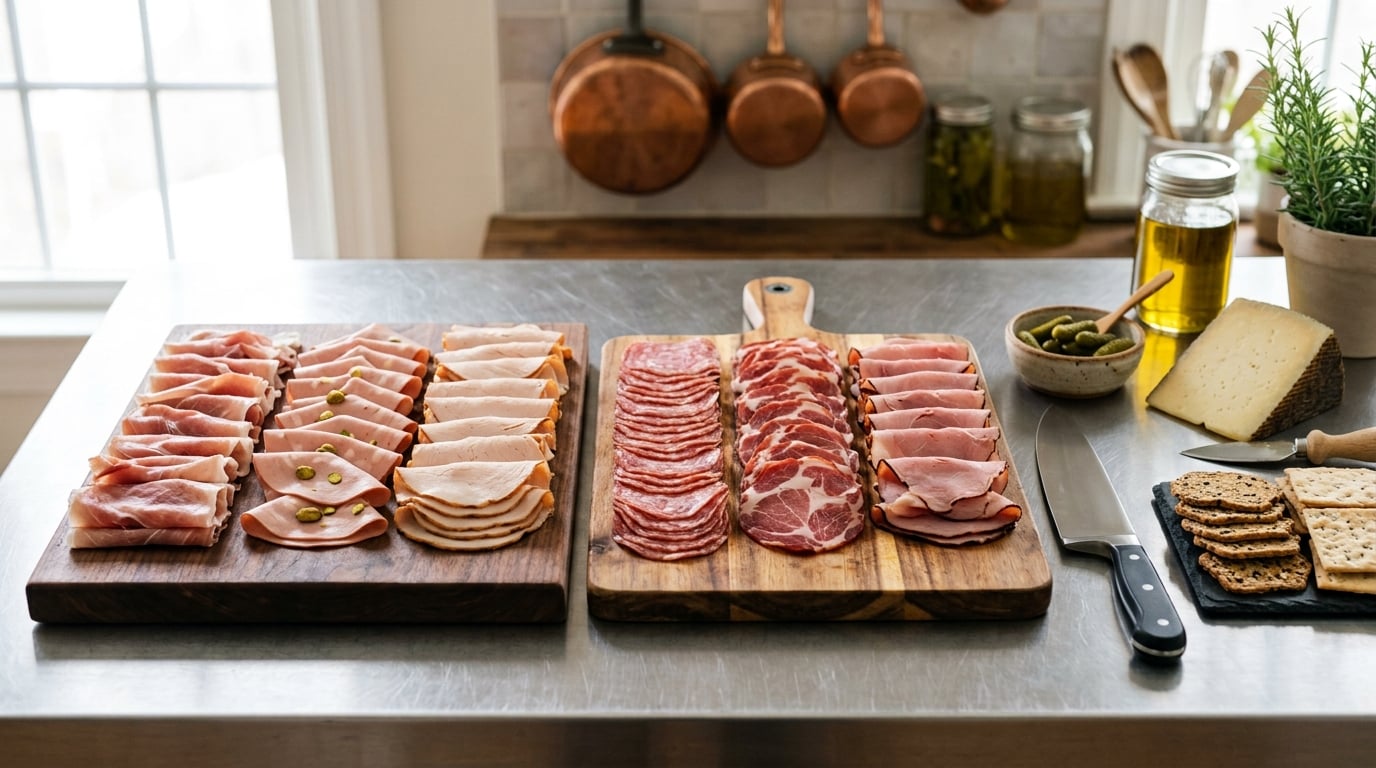
Neither brand wins for everyone. Boar’s Head is the better buy when you want one name to trust across every supermarket in the country and a deli counter that slices it fresh. Dietz & Watson is the better buy when flavor character matters more than shelf presence, and you can actually get it where you live. The real question is not which logo is better, it is which specific cut in front of you earns its higher per-pound price.
I have made a lot of sandwiches for this site, and most weeks the same two packs come out of the fridge. That experience is why the answer below is a framework rather than a declaration.
One warning before we start. The two brands do not sell identical products at identical sizes, and shelf prices move constantly by region, retailer, and package size. Nothing here quotes a price, because a quoted number goes stale within weeks. What holds up is the shape of the comparison: where the money goes, what changes in the sandwich, and which brand wins each use case.
Table of Contents
- Boar’s Head vs Dietz & Watson at a Glance
- Price and Everyday Value
- Ingredients, Sourcing, and Product Quality
- Taste, Texture, and Sandwich Performance
- Health and Nutrition Considerations
- Selection, Convenience, and Availability
- Which Should You Choose?
- Frequently Asked Questions
- Conclusion: Start With the Product, Not the Logo
Boar’s Head vs Dietz & Watson at a Glance
This is the short version. Read it, then skip to the section matching your situation.
| Criterion | Boar’s Head | Dietz & Watson |
|---|---|---|
| Founded | 1974, Salem, Virginia | 1893, Philadelphia, Pennsylvania |
| Ownership | Privately held, corporate structure | Family heritage, owned by DiGiovanni Foods since 2014 |
| Typical texture | Firm, dense, substantial bite | Softer, more yielding bite |
| Flavor profile | Clean, mild, classic deli counter taste | Spiced, slow-roasted, more seasoned-forward |
| Price position | Higher per pound | Moderate; often below the national brand |
| Distribution | National, most supermarkets nationwide | Concentrated in the Northeast and Mid-Atlantic |
| Deli counter presence | Branded service deli with brand staffing | Distributor model, store-sliced more often |
| Cuts worth trying | Ovengold turkey, Super Sandwich ham, rare roast beef | London Broil, first-cut pastrami, Bacon Lover’s Turkey |
| Best for | Daily lunches, one-brand shopping, kids’ sandwiches | Hoagies, charcuterie boards, bolder flavor seekers |
Read the texture row twice. It explains more sandwich outcomes than any other line on that list, and it is the difference you notice first when you take a bite.
Price and Everyday Value
Boar’s Head costs more per pound. That is the single most consistent difference between the two brands, and shoppers who do five sandwiches a week feel it every month.
The gap comes from a few places, and only one of them is about the meat itself.
Why the national brand costs more
A brand that builds a service deli inside a supermarket is selling more than cold cuts. It supplies signage, equipment, a branded case, and often a trained brand ambassador who slices behind the counter for part of the week. The supermarket recoups that cost in margin, and shoppers absorb part of it. Dietz & Watson mostly runs a distributor model, where the grocery store buys cases and slices them itself. Less overhead shows up as a lower shelf price.
The other half is perception. A brand that has been advertising in your region for decades can charge more for the same pound of turkey, and shoppers have trained themselves to accept that. Call it brand equity, but it behaves like a price premium you pay for familiarity.
What the premium actually costs per sandwich
Do the math yourself with a pack in front of you. Weigh the package, count the slices, and divide the shelf price by the number of slices. A quarter-pound sandwich uses roughly four slices of a typical 0.25 to 0.35 inch cold cut. Two slices is a small sandwich, four is a standard one.
That calculation changes the answer for different households. For someone eating one sandwich a day, the difference is a modest monthly cost. For a family of four packing five lunches a week, it adds up fast enough that the brand choice becomes a budgeting decision rather than a taste decision.
My own rule: below about four sandwiches a week, buy the better sandwich. Above ten, buy the better deal and spend the difference on cheese or produce, where the improvement is more obvious per dollar.
Ingredients, Sourcing, and Product Quality
Premium deli meat marketing is heavy on words like craft, old-world, and naturally cured. The label tells you more than the slogan, and reading takes about fifteen seconds.
What to read on the label
Look at the first three ingredients, then find the sodium line. Short ingredient lists that start with the meat and poultry you expect are a genuine signal of a simpler product. Long lists with a string of stabilizers, binders, and modified food starches usually signal a product engineered for sliceability and shelf life rather than flavor.
Check whether the product is labeled uncured. Uncured means no added nitrite or nitrate, and it does not mean the product is healthier overall, because uncured versions are frequently higher in sodium to compensate for flavor and preservation. Treat uncured as a preference, not a nutrition win.
Finally, look at the sodium per serving and compare it against the serving size on the same line. Many labels advertise a low number because the serving is small.
Sourcing and production claims
Both brands talk about their plants and their suppliers, and both publish quality standards. Neither publishes a single number that lets you rank them, so treat these claims as brand material rather than evidence.
The difference that is verifiable is the range of cuts. Dietz & Watson makes several items Boar’s Head does not, including London Broil, Bacon Lover’s Turkey, and Southern Fried Chicken Breast. For a deli shopper who likes comparing, that variety matters more than a production-standard claim that reads the same on both packages.
The safety record you should weigh
This is the strongest argument against paying the national premium right now. In July 2024, Boar’s Head recalled a wide range of meats and cheeses linked to a listeria monocytogenes outbreak, and the company later discontinued its liverwurst line. The Virginia facility involved had production suspended for an extended period, with later reporting describing a gradual reopening rather than a full return.
Dietz & Watson has had far less attention from that angle. Absence of headlines is not the same as a perfect record, but if you are making this choice in 2026 and safety is on your list, the recall history tilts clearly toward the Philadelphia brand.
In a thread on r/Sandwiches asking what people switched to after the recall, several posters said they moved to Dietz & Watson and others went to store-brand house-made slices entirely. Whatever you decide, keep cold cuts refrigerated and follow the use-by window on the package.
Taste, Texture, and Sandwich Performance
Boar’s Head slices firm and dense, with a clean, mild flavor that stays out of the way of the rest of the sandwich. Dietz & Watson slices softer and carries more seasoning, closer to a traditional Philadelphia deli counter.
That difference changes what each one is good for.
Everyday packed lunches
Kids and adults eating the same sandwich on repeat want predictability, and Boar’s Head delivers a consistent slice that holds up to a lunchbox by afternoon. A firm slice does not turn rubbery and it does not bleed moisture into the bread. For a school lunch packed at 6am and eaten at noon, that reliability is worth more than a bolder taste.
Hoagies and Italian subs
A hoagie is built on heat, bread, and a pile of meat. Soft slices compress and bend into the roll, and seasoned meat contributes flavor that a mild slice will not. Most people who grew up eating a real Italian sub came out of a household that bought Dietz & Watson, and it shows in their preference.
Hot sandwiches and melting
Grilling or toasting changes the rules. A dense slice browns and crisps at the edges; a soft slice warms through and picks up the flavor of the bread and toppings. Neither is wrong, but they are not interchangeable in a patty melt or a Cuban.
Charcuterie and party platters
On a board, variety and character matter more than consistency. This is where a spiced, slow-roasted cut earns its price, because it stands next to cheese and pickles and holds its own. A milder slice disappears on a board surrounded by sharper things.
Run your own blind taste test
Buy one package of each, slice them the same thickness, and taste them plain before you add anything. Score bite, flavor intensity, salt, and moisture on a one to five scale. Do it twice, on different days, since the first round favors whichever brand you are thinking about. Your palate is more reliable than any review, and it takes ten minutes.
Health and Nutrition Considerations
No premium deli meat is a health food, and no brand name changes the nutrition facts panel. The category in general is high in sodium and often high in fat, and both brands sell products across that range.
Dietz & Watson is widely described by shoppers as usually less expensive for a similar cut, which means a lower per-pound sodium intake for the same amount of meat. That is arithmetic, not a claim about the recipes.
Product selection matters more than brand. Roast beef, turkey breast, and lower-sodium deli selections are different products from bologna, salami, and liverwurst, and the difference between them dwarfs the difference between two premium brands. Portion size and frequency matter more too, and the rest of the sandwich usually contributes more sodium than the meat does.
If you are following a low-sodium plan, read the current label rather than trusting a brand reputation. Some products in both lines run high, and the number can change when a recipe is reformulated.
For anyone with a specific medical or dietary concern, talk to a doctor or a registered dietitian rather than a sandwich article, including me.
Selection, Convenience, and Availability
Availability is where the two brands are least similar, and it is the most common reason people assume the choice was never really on the table.
The regional problem
Dietz & Watson is a Northeast and Mid-Atlantic brand with a distribution footprint that thins out fast past that region. In New Jersey, Philadelphia, Baltimore, and New England you will find it in a range of supermarkets and delis. In Chicago, San Diego, or the Mountain West, shoppers frequently report having to make a special trip or order it. Boar’s Head, by contrast, is the default premium cold cut in most grocery chains nationwide.
If Dietz & Watson is not carried by the stores within a reasonable drive, the comparison is theoretical. Boar’s Head wins that scenario by default.
Deli case exclusivity
Some stores run a branded Boar’s Head service deli, which can limit what other premium brands the store will carry. This is a real constraint that shoppers run into when they try to switch brands without switching stores. If your grocery store only sells one premium brand, that brand wins regardless of the numbers in this article.
Pack sizes, refrigeration, and shelf life
Both brands sell pre-packaged vacuum-sealed packs that keep well refrigerated, and both sell bulk quantities meant for the deli case. If you buy a family-size pack to save per slice, plan to slice it yourself at home and freeze what you will not use within a few days. A freezer turns a bulky pack into several small packs, which is the practical way to buy premium meat on a budget.
Where to find each
Boar’s Head appears in most major supermarkets, many independent delis, and online grocery delivery in most regions. Dietz & Watson shows up in Northeast chains, regional grocers, Italian markets, and a growing run of online shippers. If you want it and your store does not carry it, ask the deli manager to order a case, since a manager can often source a brand that is not on the shelf plan.
Which Should You Choose?
Pick by use case, and the answer stops being ambiguous.
Choose Boar’s Head if you want one dependable name for every trip to the store, if you are feeding kids who need a mild predictable slice, or if you mostly make cold sandwiches that sit for an hour before eating. The national footprint alone justifies it for a lot of households.
Choose Dietz & Watson if you build hoagies, if you are doing a charcuterie board, if you want cuts the national brand does not make, or if you are buying premium meat as an occasion rather than a weekly default. Shoppers in the Northeast already know these cuts, and London Broil plus first-cut pastrami are the two to start with.
Choose house-made store brand if the objection is price and the quality bar is high. Across the forums we looked at, store-brand deli meat made in store rated above both national brands more often than not, and it costs less than either. This is the option that satisfies the money objection and the quality objection at the same time.
Choose neither, right now if the recall history is the deciding factor for you. Dietz & Watson is the better pick of the two, and house-made is better still.
For a shopper comparing one specific sandwich, the tiebreaker is the cut, not the brand. A well-made turkey breast from either company beats a mediocre ham from either company.
Frequently Asked Questions
Is Dietz and Watson as good as Boar’s Head?
It depends on the cut and what you are making. Dietz and Watson is equal or better for hoagies, charcuterie boards, and anyone who wants a spiced, slow-roasted flavor. Boar’s Head is equal or better for mild everyday packed lunches, hot sandwiches, and shoppers who want one brand carried everywhere. Compare the specific product, not the logo.
What’s better, Dietz u0026amp; Watson or Boars Head?
Dietz u0026amp; Watson wins on flavor character, variety of cuts, and usually on per-pound cost. Boar’s Head wins on national availability, consistency, and mildness for kids’ sandwiches. If your store only carries one of them, the one it carries is the practical winner. If both are available, choose by sandwich rather than by brand.
Is Boars Head the best deli meat to buy?
Best is the wrong question, because the two brands sell dozens of products with widely different nutrition and flavor profiles. A premium turkey breast from either company is a different food from bologna or liverwurst. Judge the specific product’s ingredients, sodium, and price per slice. That comparison is far more useful than ranking two brands against each other.
Do Dietz and Watson have nitrates?
Most Dietz and Watson products are cured, which means they contain added nitrite or nitrate from curing salt unless the package specifically says uncured. Several products are sold in uncured versions. Read the ingredient list rather than the front of the package, and note that uncured versions often carry more sodium for flavor and preservation.
Why is Boar’s Head more expensive than Dietz and Watson?
Three reasons. Boar’s Head funds a branded service deli with signage, equipment, and often brand staffing, while Dietz u0026amp; Watson more often runs a distributor model where the store slices cases itself. Boar’s Head also carries national brand recognition, and a consumer can buy a familiar name at a premium. Some of the difference is product cost, and some is brand equity.
Where can I buy Dietz u0026amp; Watson outside the Northeast?
Dietz and Watson is strongest in the Northeast and Mid-Atlantic. Elsewhere, look in regional grocers, Italian markets, and online grocery delivery, and ask the deli manager to order a case, since managers can often source a brand that is not on the shelf plan. If you cannot get it within a reasonable drive, the comparison is not worth much.
Conclusion: Start With the Product, Not the Logo
Boar’s Head is worth the premium if you need one dependable national brand and a mild, firm slice. Dietz & Watson is worth the premium if you want deli-style flavor and cuts the national brand does not make. Buy whichever specific product fits the sandwich you are actually making, and buy house-made when the budget is tight.
Start with the pack in front of you. Check the price per slice, read the first three ingredients, check the sodium serving, and taste it plain. That four-step check tells you more than either logo does.