
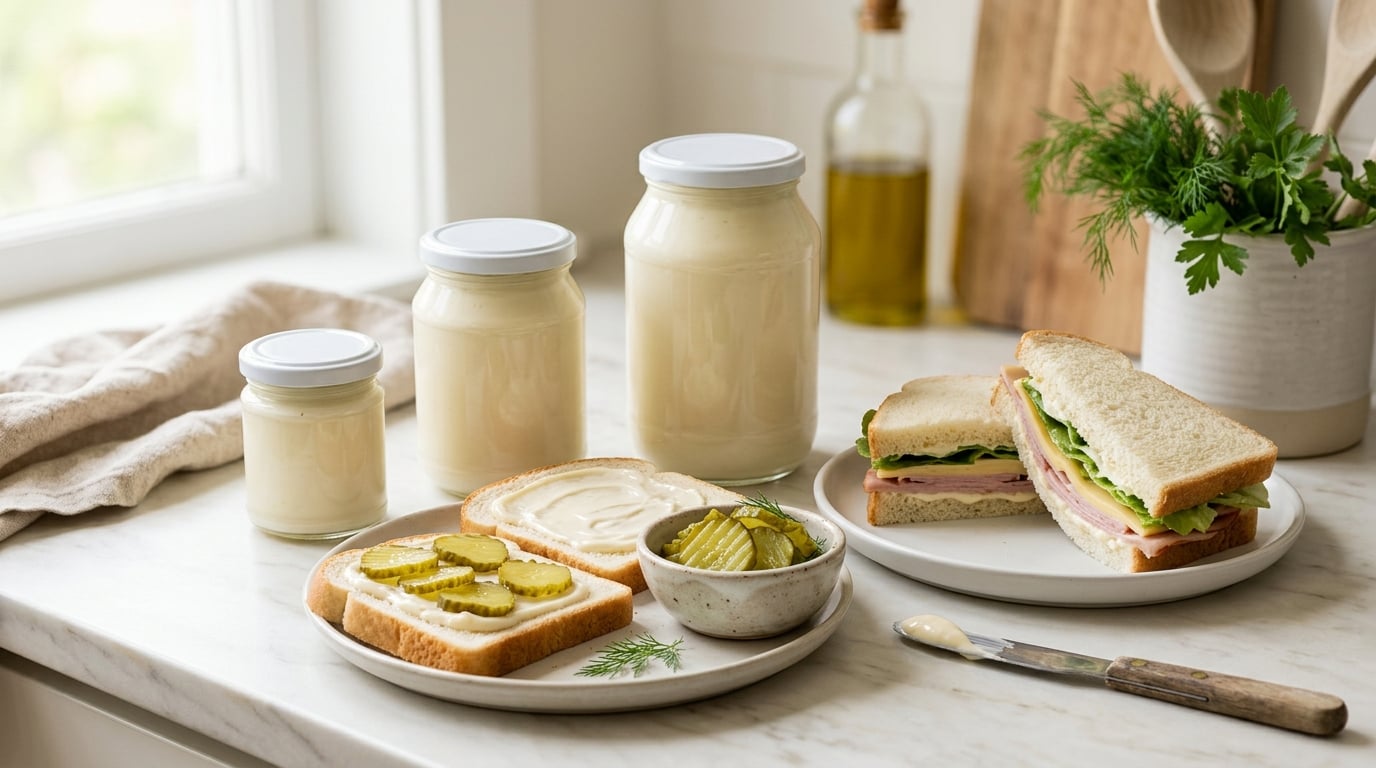
If you only have room for one jar on the fridge door, buy Hellmann’s, sold as Best Foods west of the Rockies. Reach for Duke’s when the sandwich is rich or tomato-heavy and you want the mayo to step back a little, and keep a squeeze bottle of Kewpie for fried chicken, katsu sandwiches and anything already loaded with savory flavor. There is no single best mayo for sandwiches, because the right jar depends entirely on what you are layering it with.
Mayonnaise is an emulsion: droplets of oil held in water by egg yolk, stabilized by the lecithin in the yolk and thinned with acid. That structure is why it behaves the way it does on bread. A thin, tangy mayo soaks into a soft roll in a few minutes, while a dense, sweet one sits on the crust and keeps a sandwich together through a commute.
That is also why two national brands that look and pour alike can behave very differently on a stacked sandwich, and why a mayonnaise developed for fried food in Japan can taste like a different category of condiment entirely.
Table of Contents
- Duke’s vs. Hellmann’s vs. Kewpie: Which Mayo Is Best for Sandwiches? at a Glance
- Taste, Texture, and Sandwich Compatibility
- Ingredients and Nutrition
- Best Pairings by Sandwich Type
- Price, Availability, and Storage
- Which Should You Choose?
- Frequently Asked Questions
- Which mayonnaise tastes best in sandwiches?
- Is Duke’s, Hellmann’s, or Kewpie better for turkey and chicken sandwiches?
- Is Kewpie mayonnaise the same as regular mayonnaise?
- Can I use Greek yogurt instead of mayonnaise in a sandwich?
- How should mayonnaise be stored after opening?
- Is it safe to leave mayonnaise on a picnic sandwich?
- The Best Mayo for Sandwiches: Final Verdict
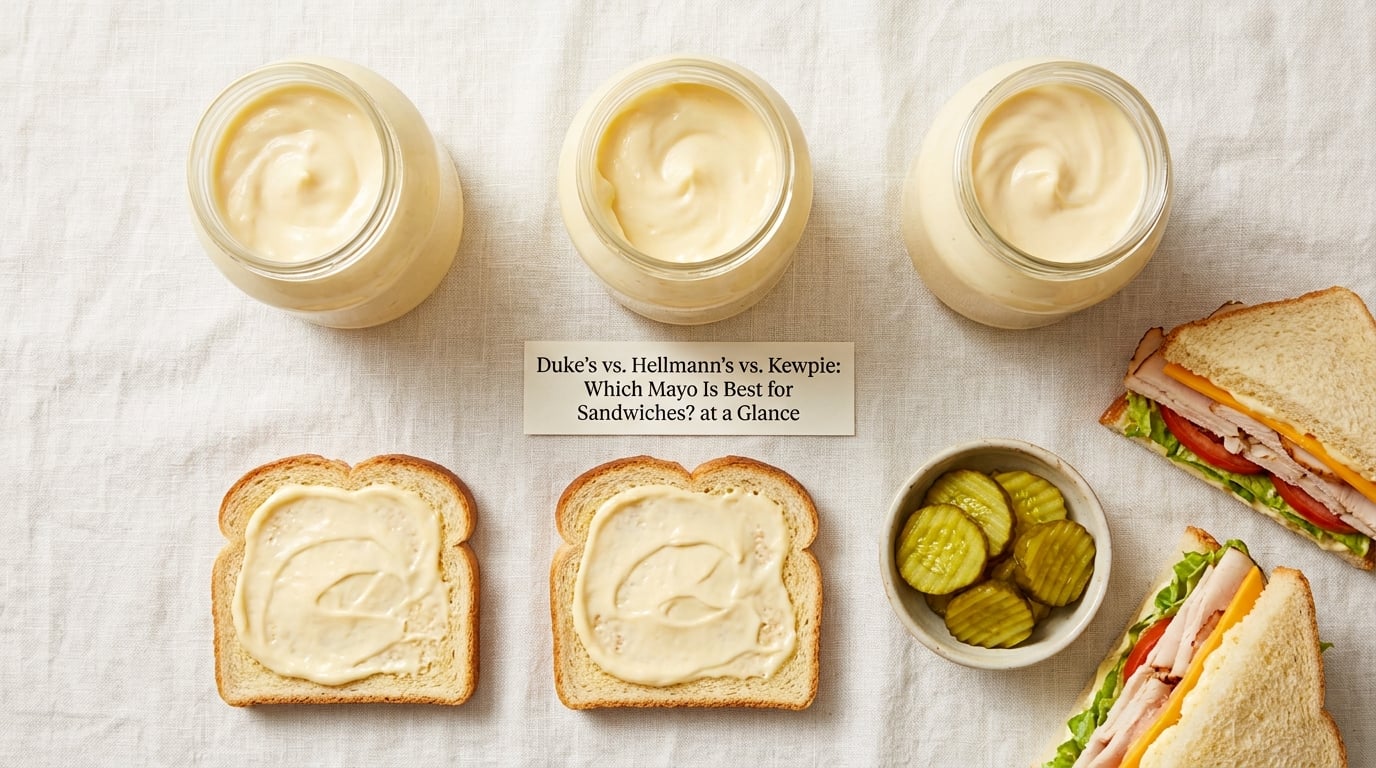
Duke’s vs. Hellmann’s vs. Kewpie: Which Mayo Is Best for Sandwiches? at a Glance
| Criterion | Duke’s | Hellmann’s / Best Foods | Kewpie |
|---|---|---|---|
| Taste | Tangy, bright, lightly sweet edge | Mild, balanced, faintly sweet | Rich, noticeably sweet and savory |
| Texture | Softer, spreads easily | Thick, holds a shape on bread | Dense and clingy, barely spreads |
| Egg base | Whole eggs | Whole eggs | Egg yolks only |
| Acid | Vinegar and lemon juice | Vinegar and lemon juice | Rice vinegar |
| Added sugar | None | Yes, a small amount | Yes, plus a little added salt |
| Color | Bright white, glossy | Pale, slightly yellow | Deep yellow |
| Strongest pairing | Tomato, BLT, roast beef, tuna salad | Turkey, ham and cheese, club, everyday use | Fried chicken, katsu sando, crab, po’ boy |
| Cost positioning | Mid-range, larger jars | Mid-range, wide regional reach | Higher per ounce, sold in smaller bottles |
Two quick notes before you shop. Hellmann’s and Duke’s are close relatives: both are whole-egg American mayonnaises acidified with vinegar and lemon, and most of the argument between them is regional habit as much as flavor. Kewpie is the outlier, built on yolks alone with rice vinegar and a small amount of added MSG, which is where the sweetness and the savory depth come from.
Taste, Texture, and Sandwich Compatibility
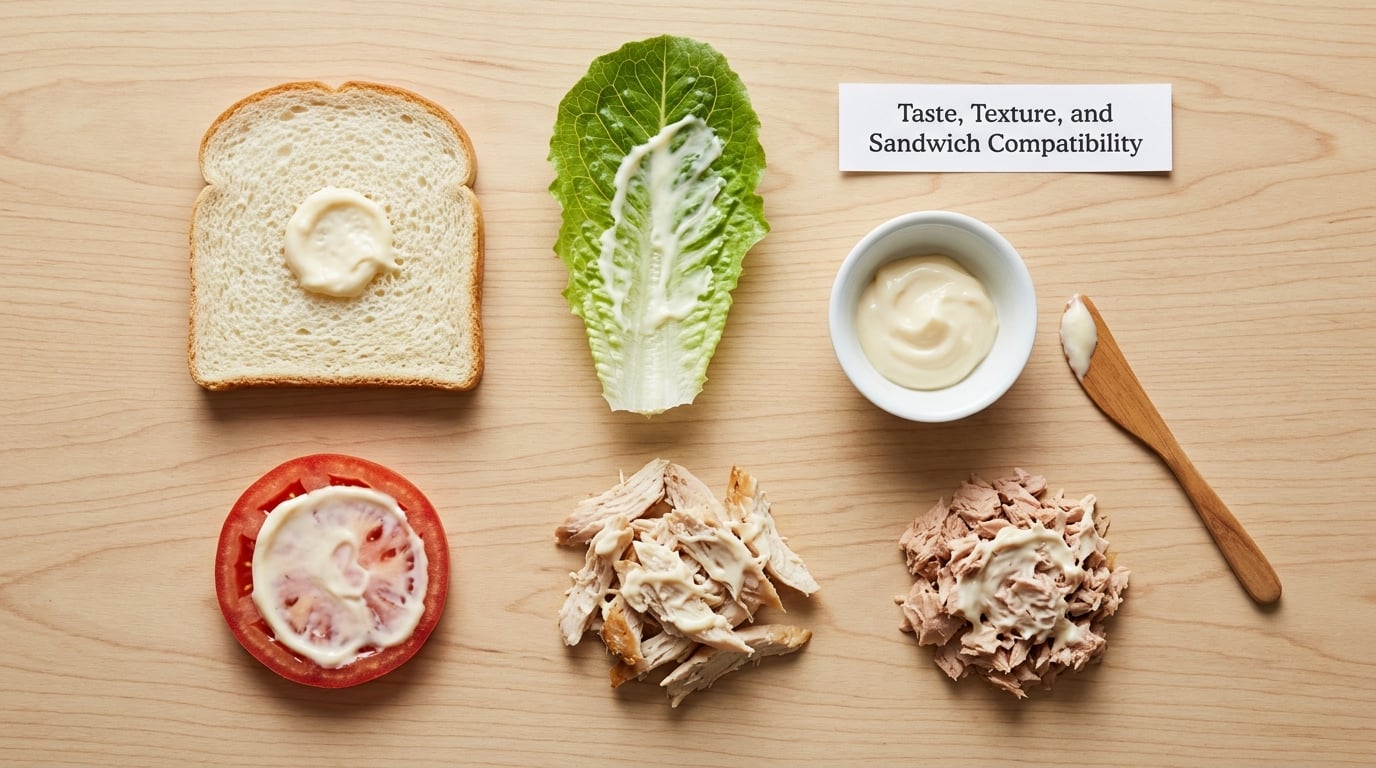
Spreadability is the practical test. Duke’s softens fastest, which is why it disappears into a tomato sandwich or a BLT without weighing the bread down. Hellmann’s holds a knife-tracked ridge without sliding, so it stays visible on a turkey club where you want to taste the mayo itself. Kewpie resists spreading altogether; you get a thin ribbon from a squeeze bottle, and that concentration is exactly the point.
Thick mayo protects a sandwich. On a crisp thing like a fried chicken fillet or a katsu cutlet, a heavy spread is a moisture barrier that slows the soggy crust problem. On a soft roll or a slice of white bread loaded with tomato, the same density turns into a wet spot within the hour.
A quick test worth doing before you commit to a jar: spread each one the same thickness on the same bread, wait ten minutes, then pick it up. The one that has already soaked in is the wrong choice for that bread, not the sandwich.
Duke’s vs. Hellmann’s vs. Kewpie: Flavor and Texture
The head-to-head verdict is short. Hellmann’s is the balanced all-rounder, closest to neutral, and the easiest jar to hand to a guest. Duke’s is the lighter, tangier option, sugar-free and more assertive, and it is what you want when the sandwich is already busy or already acidic. Kewpie is the richest and sweetest, the most distinctive of the three, and the one most likely to surprise somebody who grew up on American mayo.
Texture tells the same story. Duke’s is the softest and spreadable, Hellmann’s is the thickest and most structured, and Kewpie sits somewhere between them but clings harder because of the yolk-only base and the rice vinegar.
Ingredients and Nutrition
Under the FDA standard of identity, mayonnaise is at least 65 percent vegetable oil, plus an egg yolk source and an acid. Miracle Whip and similar dressings fall outside that definition because they are sweetened and thickened without relying on enough egg. If a sandwich is your priority, real mayonnaise is the category to compare.
| Label point | Duke’s | Hellmann’s / Best Foods | Kewpie |
|---|---|---|---|
| Egg | Whole eggs | Whole eggs | Yolks only |
| Oil | Canola oil | Canola oil | Soybean and rapeseed oils |
| Acid | Vinegar, lemon juice | Vinegar, lemon juice | Rice vinegar |
| Sweetener | None | Sugar | Sugar |
| Flavor notes | Clean, briny | Rounded, faintly sweet | MSG and salt, deep savory |
| Approx. calories per tablespoon | 90 | 90 | 80 |
Read those numbers as rough figures from current labels rather than a precision instrument, and check the jar in your hand since recipes shift. The calorie load of all three is dominated by the oil, so none of them is a meaningfully lighter choice for a sandwich. The differences that do matter on a label are sodium and added sugar, and both run higher for Kewpie than for a standard jar.
Light and reduced-fat versions exist for all three. They spread more readily, which some people like on a large sandwich, but they cut into the flavor and can taste thin next to a heavily seasoned filling. If you eat mayo every day, that is a sensible swap. If you are building one good sandwich, buy the real thing.
Best Pairings by Sandwich Type
| Sandwich | Duke’s | Hellmann’s / Best Foods | Kewpie |
|---|---|---|---|
| Turkey and cheese | Good | Best | Fair, too sweet for plain turkey |
| Ham and cheese | Good | Best | Fair |
| Roast beef on rye | Best | Good | Fair |
| Tuna or egg salad | Best | Good | Good, richer bowl |
| BLT | Best | Good | Too sweet against bacon |
| Club sandwich | Good | Best | Works on a bacon-heavy club |
| Tomato on white bread | Best | Good | Overpowering |
| Fried chicken or katsu sando | Good | Good | Best |
| Po’ boy or shrimp roll | Fair | Good | Best |
| Vegetable or cucumber sandwich | Best | Good | Good, a little sweet |
Kewpie’s sweetness is the whole ballgame here. On a sandwich where every other ingredient is savory and fried, that sugar and MSG read as depth. On a sandwich built around a cool, delicate filling like cucumber, celery or plain sliced turkey, the same bottle reads as dessert. That is not a flaw, it is a mismatch.
Price, Availability, and Storage
Cost per tablespoon tells you more than the shelf tag. Duke’s and Hellmann’s typically sell in large multi-ounce jars that run under a couple of dollars per pound, while Kewpie sells in smaller squeeze bottles priced higher per ounce. Kewpie’s argument is that you use a quarter as much of it per sandwich, so the real cost gap narrows after a few weeks of regular use.
Availability is regional. Duke’s dominates the South and much of the East, Hellmann’s is the national default, and Best Foods is the same recipe sold under the Hellmann’s name west of the Rockies. Kewpie sits in Asian grocery aisles and in Japanese sandwich and burger shops, with the import sometimes stocked online rather than in the supermarket.
For storage, follow the jar. All three are sold refrigerated and want continuous refrigeration after opening, with a date from the manufacturer printed on the label. Do not leave a jar on the counter for a week and expect to use it weeks later; if you only use mayo occasionally, a smaller container and a weekly fridge check keep waste down.
Which Should You Choose?
Match the jar to the sandwich you actually eat most:
- Everyday versatility: Hellmann’s or Best Foods. It is the least opinionated of the three and works on turkey, ham, club and grilled cheese without adjustment.
- Tomato, BLT, roast beef, tuna: Duke’s. The sugar-free tang cuts through fat and acid instead of sitting on top of it.
- Fried chicken, katsu sando, po’ boy, shrimp roll: Kewpie. The sweetness and umami belong next to fried food.
- Someone in the house is egg-allergic: Hellmann’s also makes a vegan mayonnaise on the same emulsifier approach, which is a genuine reason to keep that brand in the house rather than a matter of taste.
- Cooking mayonnaise-based things like potato salad: Kewpie, if you want depth, or Duke’s if you want the potato to lead.
If you are new to Kewpie, buy the smallest bottle you can find and try it on a fried chicken sandwich before committing to a jar. That single test tells you more than any list.
Frequently Asked Questions
Which mayonnaise tastes best in sandwiches?
For most sandwiches, Hellmann’s (or Best Foods west of the Rockies) is the safest pick because it is mild and balanced and will not compete with the filling. Duke’s wins on tomato, bacon and tuna, where its sugar-free tang cuts through fat. Kewpie wins on fried chicken, katsu sandwiches and po’ boys, where its sweetness and MSG read as depth. There is no universal winner, only the right match for the build.
Is Duke’s, Hellmann’s, or Kewpie better for turkey and chicken sandwiches?
For a plain turkey and cheese sandwich, Hellmann’s is the better fit, since Duke’s tang can read as sharp against cold deli meat and Kewpie’s sugar is too sweet there. For a roasted or herb chicken sandwich, Kewpie works well because the roasted flavor matches its savory profile. Duke’s sits in the middle for chicken salad, where its acidity suits a mayonnaise-based filling.
Is Kewpie mayonnaise the same as regular mayonnaise?
No. Kewpie uses egg yolks only rather than whole eggs, rice vinegar instead of distilled white vinegar, and adds a small amount of MSG and extra salt. That is why it is darker yellow, denser, sweeter and more savory. The version sold in US squeeze bottles is also made with soybean and rapeseed oils, while the bagged product imported from Japan uses a different oil and a stronger rice vinegar bite, so the two Kewpie products do not taste identical.
Can I use Greek yogurt instead of mayonnaise in a sandwich?
Yes, for most cold sandwiches. Plain Greek yogurt gives the tang and moisture of mayonnaise with less fat, and it holds up on bread for about the same length of time. It will not behave the same way in a tuna or egg salad, where the body of the dressing matters, and it cannot be heated without splitting. Use full-fat yogurt if you want a closer texture, and season it with salt and a squeeze of lemon.
How should mayonnaise be stored after opening?
Keep it refrigerated at or below 40 degrees Fahrenheit and use it within the window printed on the manufacturer label, which is usually a few months after opening. Mayo is high in oil but low in acid, so it does not keep well on a warm counter or in a car. If the jar has been unrefrigerated for more than about two hours, discard it rather than tasting it to check.
Is it safe to leave mayonnaise on a picnic sandwich?
Treat it like any perishable filling. Keep assembled sandwiches under 40 degrees or on ice and eat them within two hours of leaving refrigeration, or one hour if the day is above 90 degrees Fahrenheit. Mayo is not the main risk on a sandwich, but it travels with deli meat, cheese, egg salad and chicken, which are the foods to watch. Pack the mayo separately if the sandwich will sit out longer than that.
The Best Mayo for Sandwiches: Final Verdict
Buy Hellmann’s or Best Foods for everyday sandwiches, Duke’s for anything tomato-forward, rich or acidic, and a small bottle of Kewpie for fried food. Test each on the sandwich you make most, spread the same thickness, and give it ten minutes before you decide. Your bread and your fillings will settle it faster than any chart.